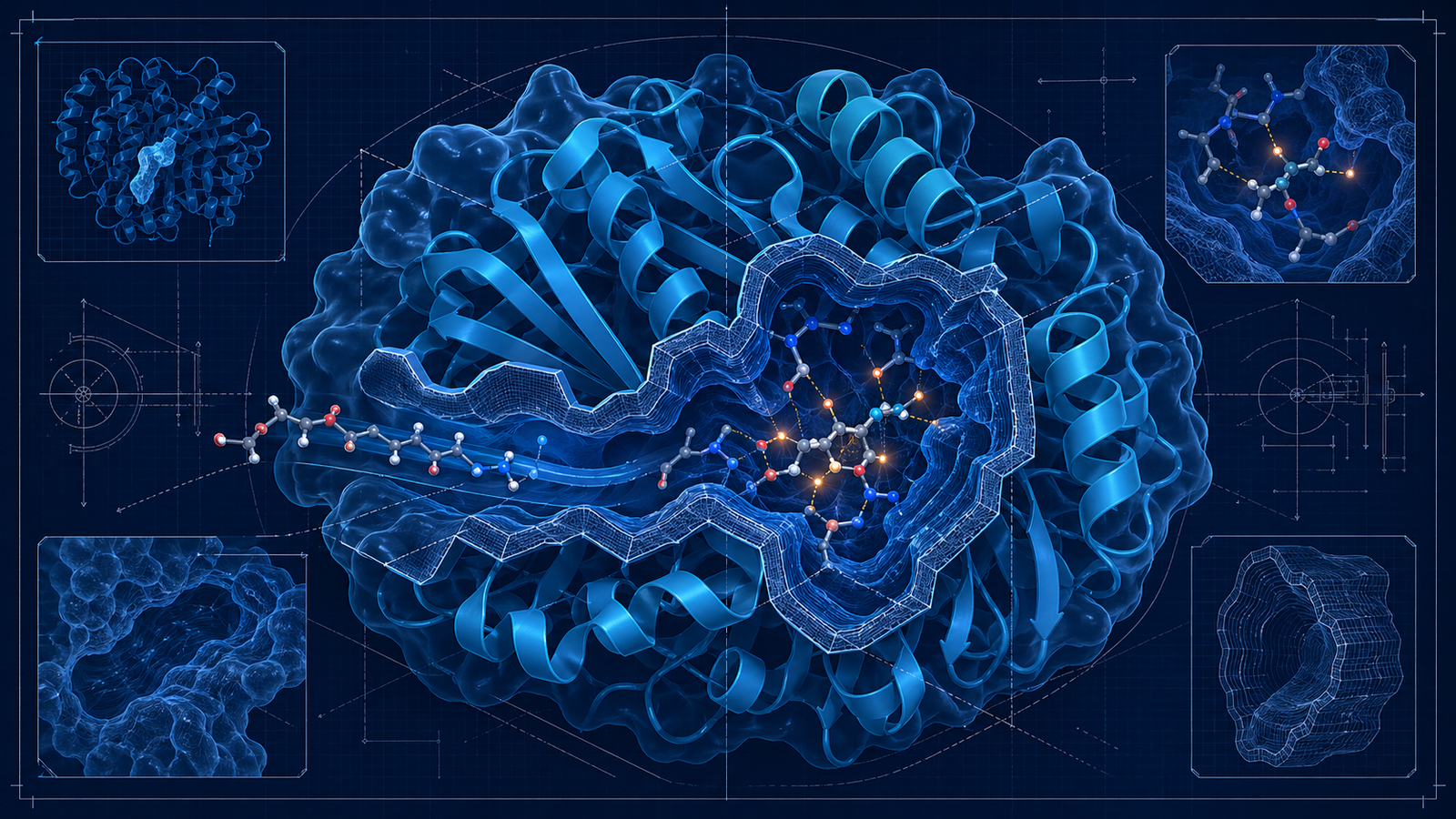
Enzyme function begins with structure. The folded architecture of a protein creates a specialized chemical environment in which substrates can bind, react, and be released as products. Although catalytic residues are essential, they represent only one part of a larger functional system. Enzyme specificity and efficiency also depend on active-site shape, access-channel geometry, loop movement, cofactor positioning, water organization, and structural networks that connect distant regions of the protein to the catalytic center (Lee & Goodey, 2011; Rajakumara et al., 2022; Ferreira et al., 2022).
The active site is often described as a pocket, but it is more accurately understood as a dynamic microenvironment. It positions substrates in productive orientations, stabilizes transition states, regulates water access, and provides functional groups that donate or accept protons, form covalent intermediates, or coordinate metal ions. Because these interactions are highly sensitive to geometry and electrostatics, even small structural changes in or near the active site can strongly affect substrate preference, catalytic rate, and reaction outcome (Selvaraj et al., 2022; Choi & Kim, 2020; Song et al., 2023).
Enzyme specificity is shaped by both direct and indirect interactions. Direct interactions include hydrogen bonding, ionic contacts, hydrophobic packing, metal coordination, and steric complementarity between the enzyme and substrate. Indirect effects can arise from residues that do not contact the substrate directly but influence pocket shape, loop positioning, electrostatic environment, or catalytic conformations. This explains why mutations far from the active site can sometimes alter activity, specificity, or stability by changing the structural and dynamic networks that support catalysis (Lee & Goodey, 2011; Osuna, 2021; Liu et al., 2021).
Conformational flexibility is another central determinant of enzyme function. Enzymes are not rigid structures; they fluctuate among multiple conformational states. Some movements allow substrate entry and product release, while others help align catalytic residues or stabilize transition-state-like conformations. Excessive flexibility can reduce stability or catalytic precision, whereas excessive rigidity can prevent the motions needed for efficient turnover. Functional enzymes therefore often operate within a carefully balanced dynamic state (Nestl & Hauer, 2014; Petrović et al., 2018; Damry & Jackson, 2021).
Structural studies are essential for explaining why enzymes with similar sequences can display different activities, selectivities, or substrate ranges. X-ray crystallography, cryo-electron microscopy, nuclear magnetic resonance spectroscopy, and computational modeling provide complementary views of enzyme architecture and dynamics. When combined with kinetic assays, mutagenesis, binding studies, and stability measurements, these methods connect structural features to measurable biochemical function (Osuna et al., 2015; Ferreira et al., 2022; Zhou & Huang, 2024).
Understanding the structural determinants of enzyme function is therefore fundamental to rational enzyme engineering. Structural insight allows researchers to redesign substrate specificity, improve catalytic efficiency, stabilize flexible or weak regions, tune conformational dynamics, and create variants with new or improved properties. In biotechnology, structure is not merely descriptive; it is a practical guide for building better enzymes (Chowdhury & Maranas, 2020; Ding et al., 2022; Zhou & Huang, 2024).
References
Choi, J. M., & Kim, H. S. (2020). Structure-guided rational design of the substrate specificity and catalytic activity of an enzyme. Methods in Enzymology. sciencedirect.com
Chowdhury, R., & Maranas, C. D. (2020). From directed evolution to computational enzyme engineering—A review. AIChE Journal. https://aiche.onlinelibrary.wiley.com/doi/abs/10.1002/aic.16847
Damry, A. M., & Jackson, C. J. (2021). The evolution and engineering of enzyme activity through tuning conformational landscapes. Protein Engineering, Design and Selection. https://academic.oup.com/peds/article-abstract/doi/10.1093/protein/gzab009/6254467
Ding, Y., Perez-Ortiz, G., Peate, J., & others. (2022). Redesigning enzymes for biocatalysis: Exploiting structural understanding for improved selectivity. Frontiers in Molecular Biosciences. https://www.frontiersin.org/journals/molecular-biosciences/articles/10.3389/fmolb.2022.908285/full
Ferreira, P., Fernandes, P. A., & Ramos, M. J. (2022). Modern computational methods for rational enzyme engineering. Chem Catalysis. cell.com)00528-0
Lee, J., & Goodey, N. M. (2011). Catalytic contributions from remote regions of enzyme structure. Chemical Reviews. pubs.acs.org
Liu, Z., Fu, X., Yuan, M., Liang, Q., Zhu, C., & Mou, H. (2021). Surface charged amino acid-based strategy for rational engineering of kinetic stability and specific activity of enzymes: Linking experiments with computational simulation. International Journal of Biological Macromolecules. https://www.sciencedirect.com/science/article/pii/S0141813021007480
Nestl, B. M., & Hauer, B. (2014). Engineering of flexible loops in enzymes. ACS Catalysis. pubs.acs.org
Osuna, S., Jiménez-Osés, G., Noey, E. L., & Houk, K. N. (2015). Molecular dynamics explorations of active site structure in designed and evolved enzymes. Accounts of Chemical Research. https://pubs.acs.org/doi/abs/10.1021/ar500452q
Osuna, S. (2021). The challenge of predicting distal active site mutations in computational enzyme design. WIREs Computational Molecular Science. https://wires.onlinelibrary.wiley.com/doi/abs/10.1002/wcms.1502
Petrović, D., Risso, V. A., Kamerlin, S. C. L., & Sanchez-Ruiz, J. M. (2018). Conformational dynamics and enzyme evolution. Journal of the Royal Society Interface. royalsocietypublishing.org
Rajakumara, E., Abhishek, S., Nitin, K., & others. (2022). Structure and cooperativity in substrate–enzyme interactions: Perspectives on enzyme engineering and inhibitor design. ACS Chemical Biology. https://pubs.acs.org/doi/abs/10.1021/acschembio.1c00500
Selvaraj, C., Rudhra, O., Alothaim, A. S., Alkhanani, M., Singh, S. K., & others. (2022). Structure and chemistry of enzymatic active sites that play a role in the switch and conformation mechanism. Current Research in Structural Biology. https://www.sciencedirect.com/science/article/pii/S1876162322000165
Song, Z., Zhang, Q., Wu, W., Pu, Z., & Yu, H. (2023). Rational design of enzyme activity and enantioselectivity. Frontiers in Bioengineering and Biotechnology. https://www.frontiersin.org/journals/bioengineering-and-biotechnology/articles/10.3389/fbioe.2023.1129149/full
Zhou, J., & Huang, M. (2024). Navigating the landscape of enzyme design: From molecular simulations to machine learning. Chemical Society Reviews. https://pubs.rsc.org/en/content/articlehtml/2023/78/d4cs00196f