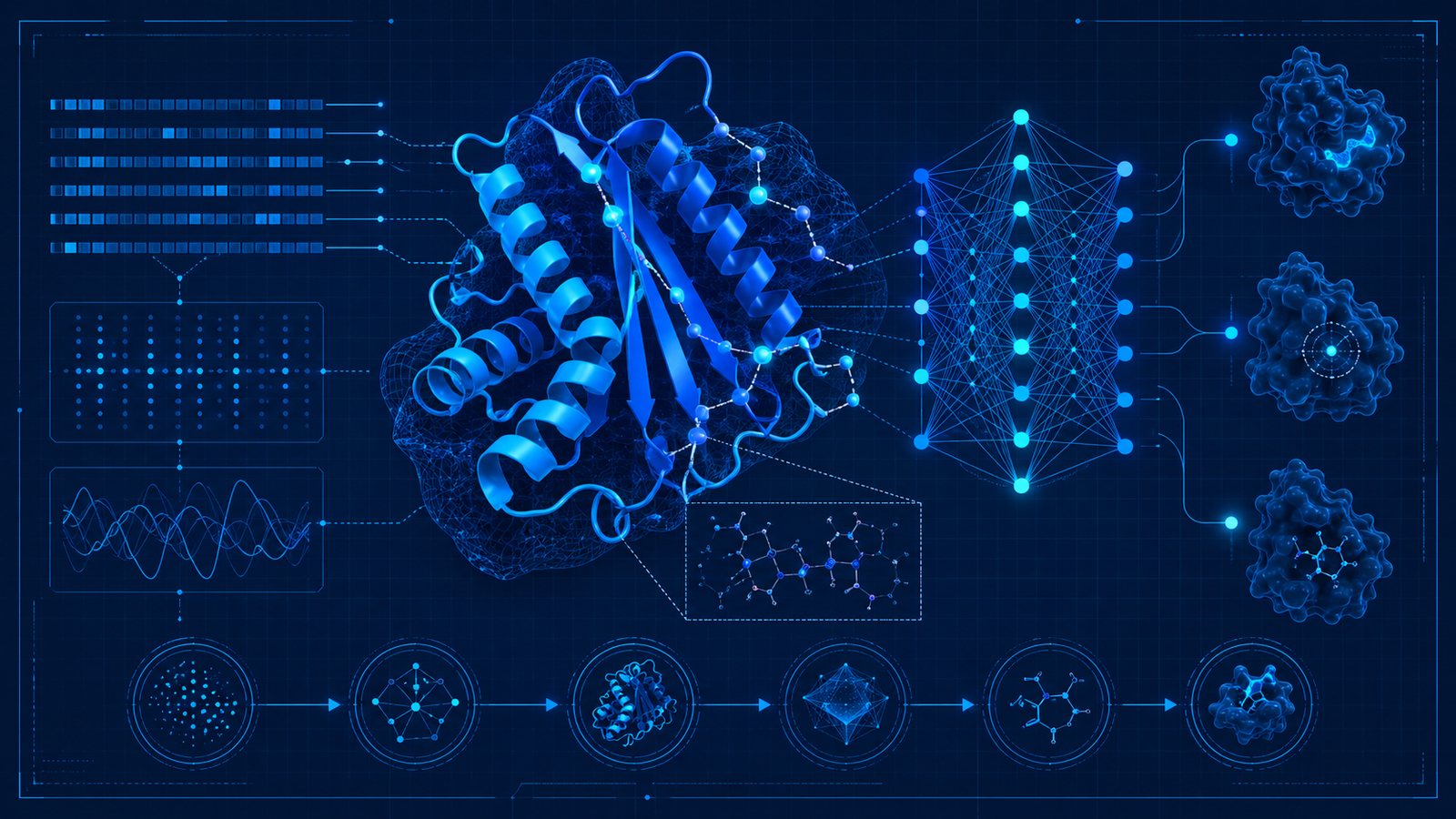
Artificial intelligence has become an increasingly important component of protein engineering, particularly as advances in structure prediction, protein language modeling, and generative design have expanded the ways researchers explore protein sequence and structure space. Instead of relying only on random mutagenesis or trial-and-error screening, scientists can now use computational models to identify promising regions of a protein, estimate the effects of mutations, and prioritize variants for experimental testing. These approaches do not replace laboratory validation, but they can make experimental design more focused and efficient (Qiu & Wei, 2023; Horne & Shukla, 2022; Koh et al., 2025).
One of the most visible contributions of AI is protein structure prediction. Knowing the approximate three-dimensional shape of a protein helps researchers examine active sites, flexible loops, domain organization, substrate-access channels, and possible stabilizing interactions. For enzymes without experimentally solved structures, AI-predicted models can provide a useful starting point for rational mutagenesis, molecular docking, comparative analysis, and stability engineering. The success of AlphaFold demonstrated how deep learning can greatly improve protein structure prediction and make structural information more accessible for biological research (Jumper et al., 2021; Qiu & Wei, 2023).
AI also supports the analysis of large protein sequence families. Protein language models and related machine-learning methods can extract patterns from thousands or millions of natural sequences, helping identify conserved residues, tolerated substitutions, co-evolving positions, and unusual sequence features. These patterns are valuable because evolution has already sampled many functional protein variants. In this sense, AI-assisted protein engineering often succeeds by learning from natural diversity rather than designing blindly from a single sequence (Mardikoraem et al., 2023; Valentini et al., 2023).
Mutation prioritization is another practical application. A single enzyme may contain hundreds of possible mutation sites, and testing all combinations experimentally is usually unrealistic. Computational models can help narrow this search space by estimating whether mutations are likely to affect folding, stability, charge distribution, active-site geometry, binding interfaces, or overall fitness. This allows researchers to design smaller, more informative mutant libraries and focus resources on variants with higher predicted potential (Horne & Shukla, 2022; Qiu & Wei, 2023).
Generative AI has further expanded the field by enabling the design of new protein sequences, scaffolds, and functional variants. These models can propose sequences that satisfy structural or functional constraints, making them useful for de novo protein design and enzyme engineering. However, generated sequences must still be evaluated carefully because a plausible sequence or predicted fold does not guarantee expression, solubility, stability, or catalytic function (Mardikoraem et al., 2023; Winnifrith et al., 2024; Koh et al., 2025).
Despite these advances, AI predictions must be interpreted with caution. A model may suggest that a mutation is stabilizing, but the real protein may behave differently because of expression problems, aggregation, altered dynamics, disrupted allostery, or reduced catalytic efficiency. Protein function depends on more than static structure; it also depends on folding pathways, conformational flexibility, solvent effects, cellular context, and reaction conditions. Therefore, purification data, activity assays, thermal profiles, kinetic measurements, and structural validation remain essential for determining whether a design is truly improved (Horne & Shukla, 2022; Qiu & Wei, 2023; Winnifrith et al., 2024).
The strongest future for AI-assisted protein engineering is not the replacement of experimental science, but a tighter partnership between computation and the laboratory. AI can generate hypotheses, reduce the search space, identify hidden sequence–structure patterns, and prioritize promising designs. Experiments can then test these predictions, reveal model limitations, and provide new data for improved computational methods. Together, AI and experimental biochemistry create an iterative design cycle that can make protein engineering more efficient, predictive, and biologically informed.
References
Horne, J., & Shukla, D. (2022). Recent advances in machine learning variant effect prediction tools for protein engineering. Industrial & Engineering Chemistry Research. https://pubs.acs.org/doi/abs/10.1021/acs.iecr.1c04943
Jumper, J., Evans, R., Pritzel, A., Green, T., Figurnov, M., Ronneberger, O., et al. (2021). Highly accurate protein structure prediction with AlphaFold. Nature. https://doi.org/10.1038/s41586-021-03819-2
Koh, H. Y., Zheng, Y., Yang, M., Arora, R., Webb, G. I., & others. (2025). AI-driven protein design. Nature Reviews Bioengineering. https://www.nature.com/articles/s44222-025-00349-8
Mardikoraem, M., Wang, Z., Pascual, N., & others. (2023). Generative models for protein sequence modeling: Recent advances and future directions. Briefings in Bioinformatics. https://academic.oup.com/bib/article-abstract/24/6/bbad358/7325909
Qiu, Y., & Wei, G. W. (2023). Artificial intelligence-aided protein engineering: From topological data analysis to deep protein language models. Briefings in Bioinformatics. academic.oup.com
Valentini, G., Malchiodi, D., Gliozzo, J., & Mesiti, M. (2023). The promises of large language models for protein design and modeling. Frontiers in Bioinformatics. https://www.frontiersin.org/journals/bioinformatics/articles/10.3389/fbinf.2023.1304099/full
Winnifrith, A., Outeiral, C., & Hie, B. L. (2024). Generative artificial intelligence for de novo protein design. Current Opinion in Structural Biology. https://www.sciencedirect.com/science/article/pii/S0959440X24000216