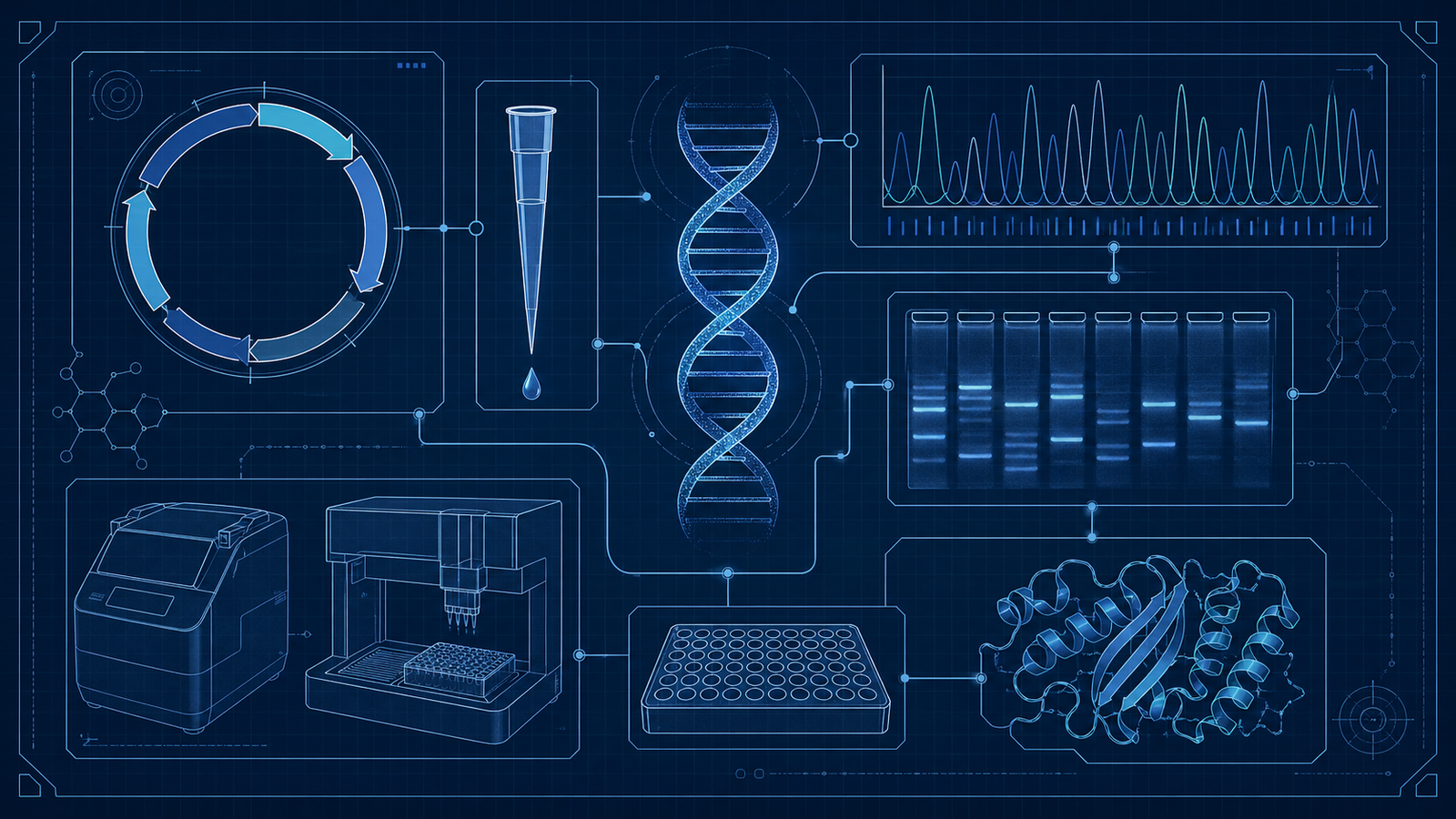
Biotechnology advances when researchers develop better tools for understanding, measuring, and controlling biological systems. The field has moved far beyond descriptive observation: scientists can now amplify genes, assemble expression constructs, edit genomes, produce recombinant proteins, analyze sequence data, measure enzyme activity, and model molecular structures. These methods transform biological questions into experimental systems that can be designed, tested, optimized, and applied in medicine, agriculture, industrial biotechnology, and synthetic biology (Glick & Patten, 2022; Katz et al., 2018).
Molecular cloning remains one of the central methods in biotechnology. By inserting genes into plasmids or other expression vectors, researchers can study gene function, produce proteins, introduce regulatory elements, and engineer new variants. Modern cloning strategies have made this process faster and more flexible, allowing multiple DNA fragments, promoters, tags, linkers, and selection markers to be assembled with greater precision. These improvements are especially important in recombinant protein production, where construct design strongly influences expression, solubility, purification, and downstream characterization (Celie et al., 2016; Ashwini et al., 2016; Sun et al., 2023).
Sequencing technologies have changed the scale of biological research. A single cloned gene can be checked for mutations, while whole genomes, transcriptomes, and metagenomes can be analyzed to discover enzymes, pathways, regulatory networks, and evolutionary relationships. For enzyme discovery, sequence databases and high-throughput sequencing provide access to natural diversity from organisms living in environments such as soil, oceans, compost, acidic habitats, and hot springs. This expands the search space for enzymes with useful properties such as thermostability, solvent tolerance, or unusual substrate specificity (Kulski, 2016; Satam et al., 2023; Bhat et al., 2022).
Genome editing adds another layer of control by allowing researchers to modify genetic information directly within cells. Programmable editing systems, including CRISPR-based tools, support gene-function studies, strain improvement, pathway engineering, and synthetic biology. In industrial biotechnology, edited microorganisms can be optimized to produce enzymes, metabolites, biofuels, pharmaceuticals, or biomaterials more efficiently. These tools are especially powerful when combined with sequencing, metabolic modeling, and high-throughput screening (Zeng et al., 2022; Katz et al., 2018; Volk et al., 2022).
Protein analysis remains essential because genetic information alone does not guarantee biological function. A cloned and expressed gene may produce a protein that is insoluble, inactive, unstable, degraded, or improperly folded. Techniques such as SDS-PAGE, Western blotting, chromatography, mass spectrometry, enzyme assays, thermal-shift analysis, and structural biology help determine whether a protein is expressed, pure, folded, active, stable, and suitable for further study. These measurements connect molecular design to biochemical reality (Kielkopf et al., 2021; Gupta & Shukla, 2016; Tripathi & Shrivastava, 2019).
The next generation of biotechnology will depend on integration. Cloning, sequencing, genome editing, recombinant expression, computational modeling, and protein characterization are most powerful when used as parts of a connected workflow. Researchers who understand both the strengths and limitations of these tools can move more effectively from biological idea to engineered application. Molecular tools do not replace biological insight; they extend it by making living systems more measurable, testable, and designable.
References
Ashwini, M., Murugan, S. B., & Balamurugan, S. (2016). Advances in molecular cloning. Molecular Biology. link.springer.com
Bhat, G. R., Sethi, I., Rah, B., Kumar, R., & Afroze, D. (2022). Innovative in silico approaches for characterization of genes and proteins. Frontiers in Genetics. https://www.frontiersin.org/journals/genetics/articles/10.3389/fgene.2022.865182/full
Celie, P. H. N., Parret, A. H. A., & Perrakis, A. (2016). Recombinant cloning strategies for protein expression. Current Opinion in Structural Biology. https://www.sciencedirect.com/science/article/pii/S0959440X16300677
Glick, B. R., & Patten, C. L. (2022). Molecular Biotechnology: Principles and Applications of Recombinant DNA. ASM Press. books.google.com
Gupta, S. K., & Shukla, P. (2016). Advanced technologies for improved expression of recombinant proteins in bacteria: Perspectives and applications. Critical Reviews in Biotechnology. tandfonline.com
Katz, L., Chen, Y. Y., Gonzalez, R., Peterson, T. C., Zhao, H., & Baltz, R. H. (2018). Synthetic biology advances and applications in the biotechnology industry: A perspective. Journal of Industrial Microbiology and Biotechnology. https://academic.oup.com/jimb/article-abstract/45/7/449/5996678
Kielkopf, C. L., Bauer, W., & Urbatsch, I. L. (2021). Expressing cloned genes for protein production, purification, and analysis. Cold Spring Harbor Protocols. cshprotocols.cshlp.org
Kulski, J. K. (2016). Next-generation sequencing: An overview of the history, tools, and “omic” applications. In Next Generation Sequencing: Advances, Applications and Challenges. https://research-repository.uwa.edu.au/files/31605052/49602.pdf
Satam, H., Joshi, K., Mangrolia, U., Waghoo, S., Zaidi, G., & others. (2023). Next-generation sequencing technology: Current trends and advancements. Biology. https://www.mdpi.com/2079-7737/12/7/997
Sun, M., Gao, A. X., Liu, X., Yang, Y., & Ledesma-Amaro, R. (2023). High-throughput process development from gene cloning to protein production. Microbial Cell Factories. https://link.springer.com/article/10.1186/s12934-023-02184-1
Tripathi, N. K., & Shrivastava, A. (2019). Recent developments in bioprocessing of recombinant proteins: Expression hosts and process development. Frontiers in Bioengineering and Biotechnology. https://www.frontiersin.org/journals/bioengineering-and-biotechnology/articles/10.3389/fbioe.2019.00420/full
Volk, M. J., Tran, V. G., Tan, S. I., Mishra, S., Fatma, Z., & others. (2022). Metabolic engineering: Methodologies and applications. Chemical Reviews. https://pubs.acs.org/doi/abs/10.1021/acs.chemrev.2c00403
Zeng, Y., Hong, Y., Azi, F., Liu, Y., Chen, Y., Guo, C., & others. (2022). Advanced genome-editing technologies enable rapid and large-scale generation of genetic variants for strain engineering and synthetic biology. Current Opinion in Biotechnology. https://www.sciencedirect.com/science/article/pii/S1369527422000595