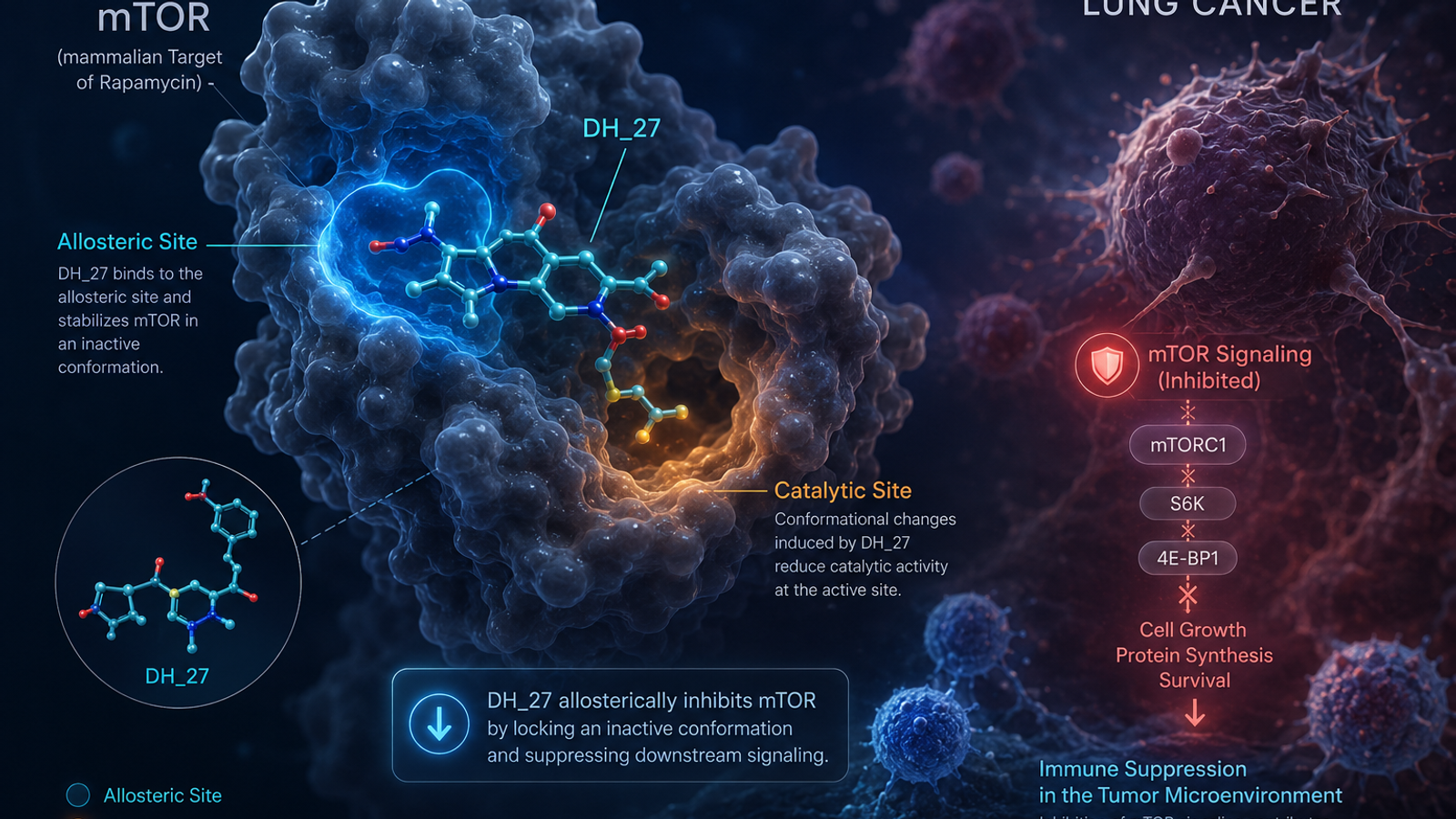
Lung cancer is one of the leading causes of cancer-related deaths worldwide, with non-small cell lung cancer (NSCLC) being the most common type. The search for effective treatments has led to the development of various therapeutic strategies, including targeted therapies that inhibit specific molecular pathways involved in cancer cell growth and survival. Recently, a novel derivative of renieramycin T, called DH_27, has shown promise in targeting lung cancer cells by inhibiting the mTOR signaling pathway.
Key Takeaways
- DH_27 is a right-half derivative of renieramycin T with potential anticancer activity
- DH_27 inhibits mTOR signaling, leading to reduced cell growth and apoptosis in lung cancer cells
- The compound exhibits cytotoxic effects on NSCLC cells with an IC50 below 10 μM
- DH_27 induces apoptosis through the intrinsic pathway, with reduced levels of anti-apoptotic proteins and increased cleavage of PARP and caspase-9
- The compound downregulates p-mTOR/mTOR expression, suppressing downstream signaling pathways, including Akt and p85S6K
Scientific Background
The mTOR signaling pathway is a critical regulator of cell growth and survival, and its dysregulation is often observed in cancer cells. Inhibition of mTOR signaling has emerged as a promising strategy for cancer treatment, with several mTOR inhibitors currently in clinical trials. However, the development of new mTOR inhibitors with improved efficacy and reduced side effects is still needed. Renieramycin T, a natural compound with anticancer activity, has been modified to generate new derivatives with potential therapeutic applications.
The Central Discovery
The study reveals that DH27, a right-half derivative of renieramycin T, exhibits potent anticancer activity against NSCLC cells. The compound induces apoptosis through the intrinsic pathway, with reduced levels of anti-apoptotic proteins and increased cleavage of PARP and caspase-9. Notably, DH27 downregulates p-mTOR/mTOR expression, suppressing downstream signaling pathways, including Akt and p85S6K. The binding affinity of DH27 to mTOR and the stability of DH27-stabilized protein-protein interactions were investigated using molecular docking and molecular dynamics simulation.
Mechanism or Core Concept
The mechanism of action of DH27 involves the inhibition of mTOR signaling, which leads to reduced cell growth and apoptosis in lung cancer cells. The compound binds to the mTOR protein at both the allosteric and catalytic sites, leading to the suppression of downstream signaling pathways. The intrinsic pathway of apoptosis is activated, with reduced levels of anti-apoptotic proteins and increased cleavage of PARP and caspase-9. The study demonstrates that DH27 is a potent anticancer agent that inhibits mTOR through allosteric and catalytic mechanisms, supporting its potential as a targeted therapy for lung cancer.
The discovery of DH_27 as a potent anticancer agent has significant implications for the treatment of lung cancer. The compound's ability to inhibit mTOR signaling and induce apoptosis in lung cancer cells makes it a promising candidate for targeted therapy. The study highlights the importance of continued research into the development of new mTOR inhibitors with improved efficacy and reduced side effects.
Therapeutic, Experimental, or Research Implications
The findings of this study suggest that DH27 may offer a new approach for the treatment of lung cancer. The compound's ability to inhibit mTOR signaling and induce apoptosis in lung cancer cells makes it a promising candidate for targeted therapy. Further research is needed to fully explore the therapeutic potential of DH27 and to investigate its efficacy in combination with other cancer therapies.
Limitations and Caution
The available source information does not provide a full limitations section, so these points should be interpreted as general scientific cautions. As with any new therapeutic agent, further research is needed to fully understand the efficacy and safety of DH_27 in humans. The study's findings are based on in vitro experiments, and additional studies are needed to confirm the compound's activity in vivo.
Future Directions
Future studies should investigate the efficacy of DH27 in combination with other cancer therapies, as well as its potential for use in other types of cancer. The development of new mTOR inhibitors with improved efficacy and reduced side effects is still needed, and DH27 may serve as a starting point for the design of new therapeutic agents.
Conclusion
In conclusion, the study reveals DH27 as a potent anticancer agent that inhibits mTOR signaling, leading to reduced cell growth and apoptosis in lung cancer cells. The compound's ability to induce apoptosis through the intrinsic pathway and downregulate p-mTOR/mTOR expression makes it a promising candidate for targeted therapy. Further research is needed to fully explore the therapeutic potential of DH27 and to investigate its efficacy in combination with other cancer therapies.
FAQ
- Q: What is the current status of DH_27 in clinical trials?
A: The current status of DH_27 in clinical trials is not available.
- Q: Can DH_27 be used in combination with other cancer therapies?
A: The study suggests that DH_27 may be used in combination with other cancer therapies, but further research is needed to confirm its efficacy.
- Q: What are the potential side effects of DH_27?
A: The potential side effects of DH_27 are not available.
- Q: How does DH_27 compare to other mTOR inhibitors?
A: The study suggests that DH_27 is a potent anticancer agent that inhibits mTOR signaling, but further research is needed to compare its efficacy to other mTOR inhibitors.
- Q: What is the next step in the development of DH_27 as a therapeutic agent?
A: The next step in the development of DH_27 as a therapeutic agent is to conduct further research to fully explore its therapeutic potential and to investigate its efficacy in combination with other cancer therapies.
Keywords: Lung Cancer, Renieramycin T Derivatives, mTOR Signaling Pathway, Apoptosis, Cancer Therapy