Article
Protein Surface Engineering and the Molecular Language of Stability
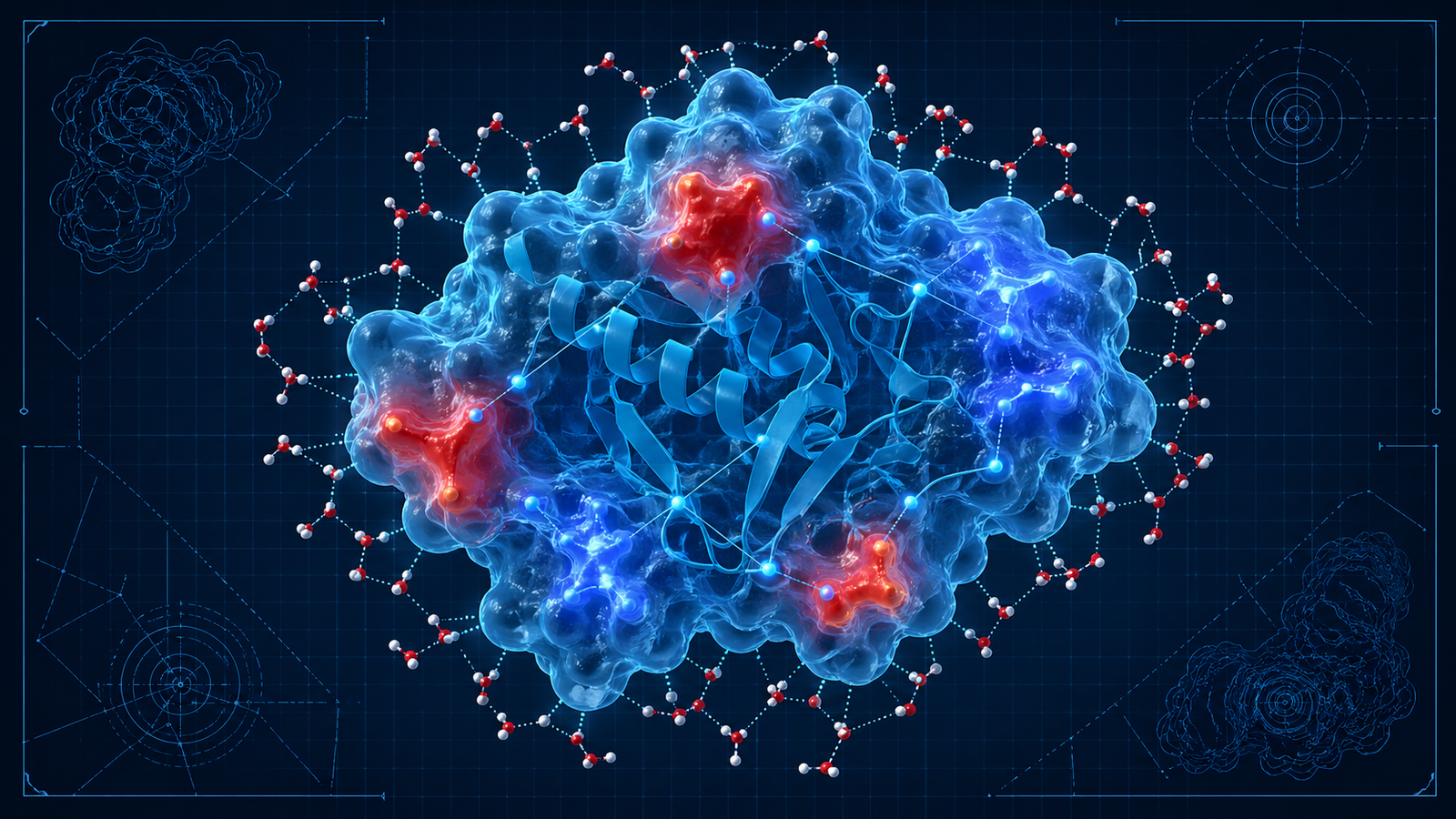
The surface of a protein is not a passive boundary; it controls solubility, interaction, aggregation, and environmental tolerance. Protein surface engineering offers a rational route to improve enzyme stability and performance without directly disturbing the catalytic core.
By Mustafa A Abdulfattah
Source details
Authors
Mustafa A Abdulfattah
Published
April 22, 2026
When researchers think about enzyme engineering, attention often goes first to the active site. This emphasis is understandable because catalysis depends on the precise arrangement of residues that bind, orient, and transform substrates. However, the protein surface is also essential. It determines how an enzyme interacts with water, salts, other proteins, membranes, purification materials, and industrial reaction environments. A stable catalytic center is useful only if the surrounding protein remains soluble, correctly folded, and resistant to aggregation under working conditions (Goldenzweig & Fleishman, 2018; Pedersen et al., 2019).
Protein surface engineering involves modifying solvent-exposed amino acids to improve practical enzyme properties. These modifications may reduce aggregation, increase solubility, improve thermostability, enhance tolerance to salts or solvents, or alter interactions with partner molecules and immobilization supports. Because surface residues are often less directly involved in catalysis than active-site residues, they can sometimes be modified with a lower risk of eliminating catalytic function. For this reason, surface engineering is a valuable strategy when the goal is to improve enzyme robustness while preserving activity (Pedersen et al., 2019; Kazlauskas, 2018; Nezhad et al., 2022).
Surface charge is one of the most important features influencing protein behavior in solution. Poorly distributed charged patches can promote nonspecific interactions, aggregation, or unfavorable protein–protein association. Introducing charged residues at strategic positions can improve solubility by increasing electrostatic repulsion between protein molecules. In some cases, engineered salt bridges or electrostatic networks on the surface can also improve thermostability, especially when these interactions stabilize flexible regions or connect structural elements that are prone to unfolding (Pedersen et al., 2019; Liu et al., 2021; Qing et al., 2022).
Exposed hydrophobic surface patches are another major concern. Hydrophobic residues are generally more stabilizing when buried in the protein core, away from water. When hydrophobic regions are exposed on the surface, they can encourage proteins to associate with one another, particularly during heating, concentration, purification, or storage. Reducing exposed hydrophobic patches through targeted mutation can therefore improve solubility, reduce aggregation, and make enzymes easier to handle in both laboratory and industrial workflows (Carballo-Amador et al., 2019; Navarro & Ventura, 2019; Goldenzweig & Fleishman, 2018).
Surface engineering can also influence protein–protein interactions. Some enzymes are naturally stabilized by oligomerization or by association with partner domains, whereas other surface-mediated interactions can reduce solubility, interfere with catalysis, or promote aggregation. By analyzing surface complementarity, electrostatic distribution, hydrophobic patches, and structural dynamics, researchers can design enzymes that interact more selectively or avoid problematic self-association (Ebo et al., 2020; Qing et al., 2022).
The strength of protein surface engineering lies in its ability to improve practical enzyme behavior without treating the protein as a black box. It connects structural biology with real-world performance by targeting features that control solubility, folding, stability, aggregation, and formulation behavior. As computational modeling becomes more accessible, researchers can increasingly identify surface weaknesses, test possible substitutions in silico, and validate promising designs experimentally. The protein surface is therefore not merely a boundary around the catalytic core; it is an important design space for enzyme engineering (Goldenzweig & Fleishman, 2018; Chowdhury & Maranas, 2020; Vega et al., 2025).
References
Carballo-Amador, M. A., McKenzie, E. A., & Dickson, A. J. (2019). Surface patches on recombinant erythropoietin predict protein solubility: Engineering proteins to minimise aggregation. BMC Biotechnology. https://link.springer.com/article/10.1186/s12896-019-0520-z
Chowdhury, R., & Maranas, C. D. (2020). From directed evolution to computational enzyme engineering—A review. AIChE Journal. https://aiche.onlinelibrary.wiley.com/doi/abs/10.1002/aic.16847
Ebo, J. S., Guthertz, N., Radford, S. E., & Brockwell, D. J. (2020). Using protein engineering to understand and modulate aggregation. Current Opinion in Structural Biology. https://www.sciencedirect.com/science/article/pii/S0959440X20300051
Goldenzweig, A., & Fleishman, S. J. (2018). Principles of protein stability and their application in computational design. Annual Review of Biochemistry. https://www.annualreviews.org/content/journals/10.1146/annurev-biochem-062917-012102
Kazlauskas, R. J. (2018). Engineering more stable proteins. Chemical Society Reviews. https://pubs.rsc.org/en/content/articlehtml/2018/cs/c8cs00014j
Liu, Z., Fu, X., Yuan, M., Liang, Q., Zhu, C., & Mou, H. (2021). Surface charged amino acid-based strategy for rational engineering of kinetic stability and specific activity of enzymes: Linking experiments with computational simulation. International Journal of Biological Macromolecules. https://www.sciencedirect.com/science/article/pii/S0141813021007480
Navarro, S., & Ventura, S. (2019). Computational re-design of protein structures to improve solubility. Expert Opinion on Drug Discovery. https://www.tandfonline.com/doi/abs/10.1080/17460441.2019.1637413
Nezhad, N. G., Rahman, R. N. Z. R. A., & Normi, Y. M. (2022). Thermostability engineering of industrial enzymes through structure modification. Applied Microbiology and Biotechnology. https://link.springer.com/article/10.1007/s00253-022-12067-x
Pedersen, J. N., Zhou, Y., Guo, Z., & Pérez, B. (2019). Genetic and chemical approaches for surface charge engineering of enzymes and their applicability in biocatalysis: A review. Biotechnology and Bioengineering. https://analyticalsciencejournals.onlinelibrary.wiley.com/doi/abs/10.1002/bit.26979
Qing, R., Hao, S., Smorodina, E., Jin, D., Zalevsky, A., & Zhang, S. (2022). Protein design: From the aspect of water solubility and stability. Chemical Reviews. https://pubs.acs.org/doi/abs/10.1021/acs.chemrev.1c00757
Vega, A., Planas, A., & Biarnés, X. (2025). A practical guide to computational tools for engineering biocatalytic properties. International Journal of Molecular Sciences. https://www.mdpi.com/1422-0067/26/3/980
More from this website
Related articles

Unlocking Gene Regulation with Single-Cell Data
A new approach, MetaFR, enables accurate prediction of gene expression by integrating single-cell ATAC-seq and RNA-seq data

CKS1B & T Cell Exhaustion
CKS1B drives T cell exhaustion in cancer by suppressing type I interferon signaling

Targeting Lung Cancer with DH_27: A Novel Derivative of Renieramycin T
A new study reveals DH_27, a right-half derivative of renieramycin T, as a potent anticancer agent that inhibits mTOR signaling, leading to reduced cell growth and apoptosis in lung cancer cells