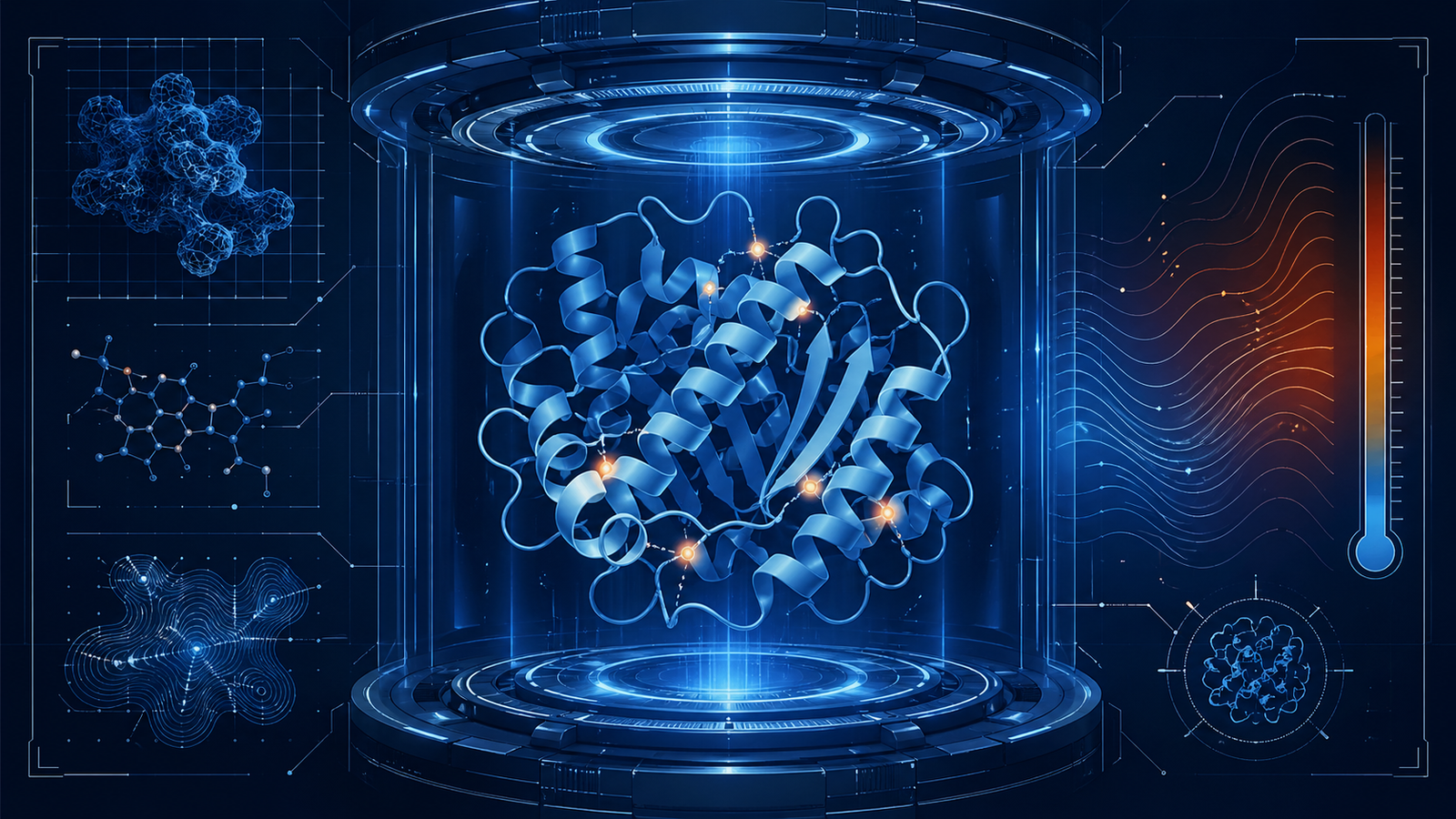
Enzyme Thermostability in Biotechnology
Enzyme thermostability is one of the most important traits in modern biotechnology because many practical applications expose proteins to conditions far from the gentle environment of the cell. Heat can accelerate chemical reactions, reduce microbial contamination, improve substrate solubility, and support industrial processing, but it can also threaten the folded structure that gives enzymes their function. A thermostable enzyme is therefore not simply a protein that remains intact at high temperature; it is a molecule whose structure, dynamics, and catalytic features remain coordinated under thermal stress (Rigoldi et al., 2018; Nezhad et al., 2022).
At the molecular level, thermostability depends on a balance of stabilizing forces. Hydrogen bonds, salt bridges, hydrophobic packing, metal coordination, disulfide bonds, and surface charge distribution all contribute to how a protein resists unfolding. No single structural feature guarantees thermal resistance. Some thermostable enzymes rely on tightly packed hydrophobic cores, whereas others depend on improved electrostatic networks, additional hydrogen bonding, or reduced loop flexibility. This diversity is one reason why thermostability engineering remains both technically challenging and scientifically rich (Yang et al., 2015; Rigoldi et al., 2018; Nezhad et al., 2022).
Thermostability is also closely connected to enzyme activity. A protein may remain folded but become less active if heat distorts the active site or disrupts essential conformational movements. Conversely, some enzymes show improved activity at elevated temperatures because increased molecular motion can support substrate access and catalytic turnover. The best engineered enzymes are therefore not simply rigid; they preserve the right type of flexibility while resisting destructive unfolding (Yu et al., 2017; Rigoldi et al., 2018).
Modern strategies for improving thermostability include directed evolution, rational design, semi-rational mutagenesis, ancestral sequence reconstruction, computational prediction, and domain-based stabilization. Each approach offers distinct advantages. Directed evolution can identify unexpected beneficial mutations, whereas rational design uses structural and mechanistic knowledge to target specific weak points. Computational tools further reduce experimental burden by screening possible mutations and guiding researchers toward the most promising enzyme variants before laboratory testing (Kaur & Sharma, 2006; Yang et al., 2015; Nezhad et al., 2022).
Thermostability is valuable beyond high-temperature industrial processes. A more stable enzyme may have a longer shelf life, greater tolerance to purification, and improved performance during storage, transport, or repeated use. In research laboratories, stable enzymes are also easier to express, purify, assay, and structurally characterize. Thus, thermostability is a practical advantage even when the final application does not involve extreme heat (Rigoldi et al., 2018; Khan, 2025).
The future of enzyme thermostability research will likely depend on integrating experimental and computational approaches. Structural biology can reveal stabilizing interactions, molecular dynamics can identify flexible or unstable regions, and biochemical assays can confirm whether predicted improvements are real. By treating thermostability as a design principle rather than a single isolated property, researchers can develop enzymes that are not only more resistant to heat but also more useful, reliable, and adaptable for biotechnology (Yang et al., 2015; Nezhad et al., 2022; Khan, 2025).
References
Kaur, J., & Sharma, R. (2006). Directed evolution: An approach to engineer enzymes. Critical Reviews in Biotechnology. https://www.tandfonline.com/doi/abs/10.1080/07388550600851423
Khan, M. F. (2025). Enhancing stability of enzymes for industrial applications: Molecular insights and emerging approaches. World Journal of Microbiology and Biotechnology. https://link.springer.com/article/10.1007/s11274-025-04568-4
Nezhad, N. G., Rahman, R. N. Z. R. A., & Normi, Y. M. (2022). Thermostability engineering of industrial enzymes through structure modification. Applied Microbiology and Biotechnology. https://link.springer.com/article/10.1007/s00253-022-12067-x
Rigoldi, F., Donini, S., Redaelli, A., Parisini, E., & Gautieri, A. (2018). Engineering of thermostable enzymes for industrial applications. APL Bioengineering. pubs.aip.org
Yang, H., Liu, L., Li, J., Chen, J., & Du, G. (2015). Rational design to improve protein thermostability: Recent advances and prospects. ChemBioEng Reviews. https://onlinelibrary.wiley.com/doi/abs/10.1002/cben.201400032
Yu, H., Yan, Y., Zhang, C., & Dalby, P. A. (2017). Two strategies to engineer flexible loops for improved enzyme thermostability. Scientific Reports. https://www.nature.com/articles/srep41212