Enzyme thermostability is a critical property in modern biocatalysis because many industrial processes operate under elevated temperatures to increase reaction rates, improve substrate solubility, reduce viscosity, and limit microbial contamination. However, enzymes from mesophilic organisms frequently lose activity under thermal stress because heat can disrupt weak intramolecular interactions, increase conformational flexibility, and promote irreversible unfolding or denaturation (Lehmann & Wyss, 2001; Eijsink et al., 2005; Kumar et al., 2000).
To overcome this limitation, several protein-engineering strategies have been developed to enhance enzyme stability, including directed evolution, rational and semi-rational mutagenesis, surface-charge optimization, disulfide engineering, consensus design, and fusion-based approaches (Bornscheuer & Pohl, 2001; Eijsink et al., 2005; Liu et al., 2019; Nezhad et al., 2022). Among these strategies, domain fusion has emerged as a useful approach because it can improve structural robustness while preserving the catalytic core of the target enzyme when the fusion is designed appropriately (Elleuche, 2015; Kim et al., 2009).
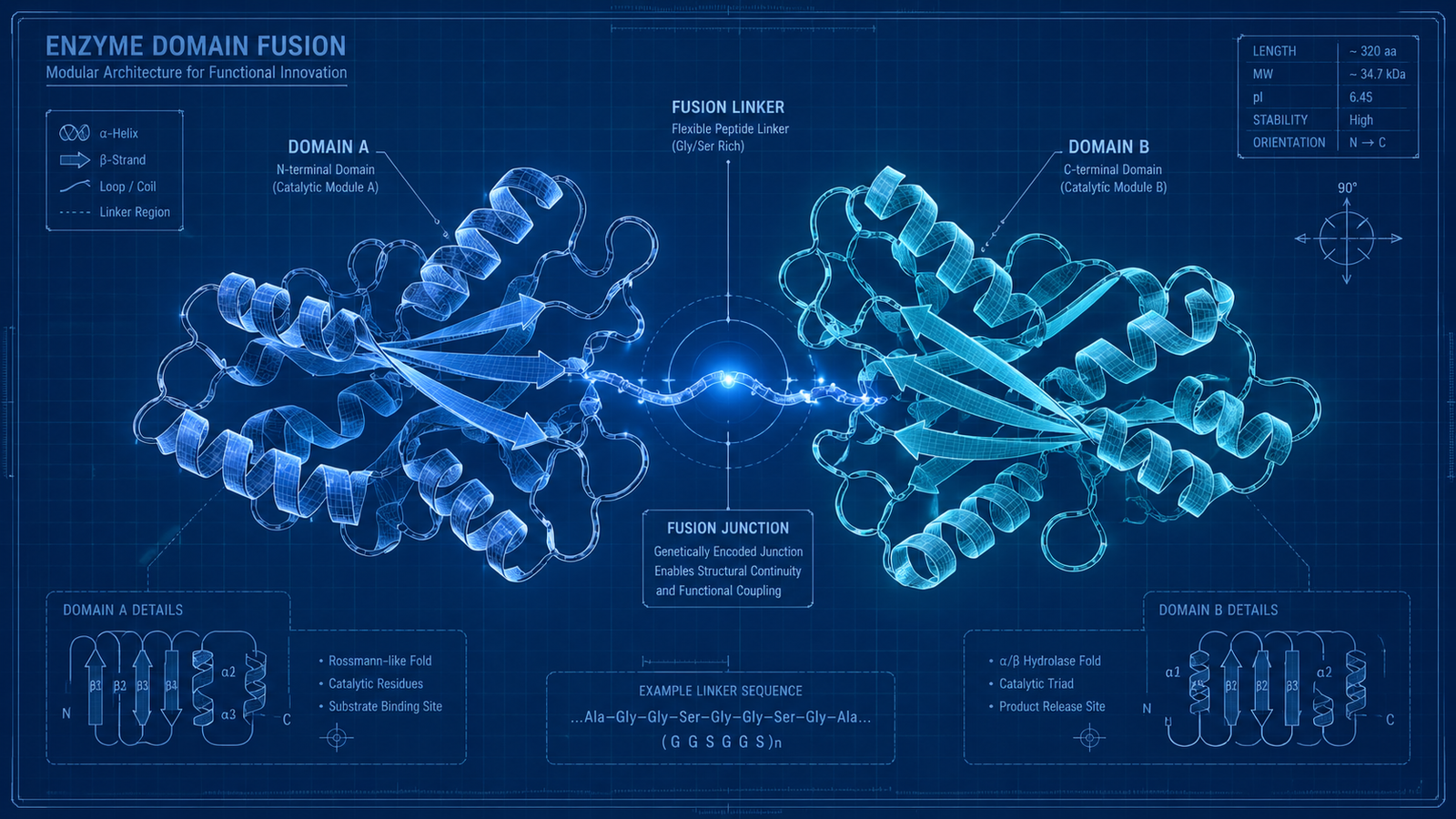
In domain-fusion engineering, a stabilizing protein domain, submodule, or fusion partner is genetically linked to the enzyme of interest to enhance folding, reduce excessive conformational mobility, or increase resistance to thermal unfolding. Thermophilic or hyperthermophilic domains are particularly attractive because they originate from proteins that naturally retain structure and function under high-temperature conditions (Kumar et al., 2000; Kim et al., 2009). For example, insertional fusion into a thermophilic host protein and domain-swapping with hyperthermophilic modules have been shown to improve the thermal stability of target enzymes in selected systems (Kim et al., 2009; Liu et al., 2012; Miao et al., 2021).
The success of domain fusion is highly design-dependent. Fusion orientation, N- or C-terminal placement, linker length, linker flexibility, steric compatibility, and the structural dynamics of both fusion partners can strongly influence whether the final construct becomes more stable or less functional. An effective fusion can enhance thermal tolerance while maintaining catalytic activity, whereas an unsuitable design may interfere with folding, active-site accessibility, substrate binding, or interdomain communication (Chen et al., 2013; Elleuche, 2015; Rizk et al., 2012).
From an applied perspective, thermostable enzymes are valuable not only because they resist heat, but also because they often perform more reliably under demanding industrial conditions. Greater thermal stability can extend enzyme half-life, support longer reaction times, improve process consistency, and reduce enzyme replacement costs, thereby increasing the practical value of biocatalysts in industrial workflows (Bornscheuer & Pohl, 2001; Eijsink et al., 2005; Nezhad et al., 2022).
As structural prediction, molecular modeling, and data-driven protein-design tools continue to improve, domain-fusion strategies are increasingly guided by structural and computational reasoning rather than empirical screening alone. This shift enables more rational selection of fusion partners, linker architectures, and attachment sites, making domain fusion a promising route for developing next-generation enzymes with improved resilience, catalytic performance, and biotechnological relevance (Dou et al., 2023; Liu et al., 2019).
References
Bornscheuer, U. T., & Pohl, M. (2001). Improved biocatalysts by directed evolution and rational protein design. Current Opinion in Chemical Biology. https://www.sciencedirect.com/science/article/pii/S1367593100001824
Chen, X., Zaro, J. L., & Shen, W.-C. (2013). Fusion protein linkers: Property, design and functionality. Advanced Drug Delivery Reviews. https://www.sciencedirect.com/science/article/pii/S0169409X12003006
Dou, Z., Sun, Y., Jiang, X., Wu, X., & Li, Y. (2023). Data-driven strategies for the computational design of enzyme thermal stability: Trends, perspectives, and prospects. Acta Biochimica et Biophysica Sinica. https://pmc.ncbi.nlm.nih.gov/articles/PMC10160227/
Eijsink, V. G. H., Gåseidnes, S., Borchert, T. V., & van den Burg, B. (2005). Directed evolution of enzyme stability. Biomolecular Engineering. https://www.sciencedirect.com/science/article/pii/S1389034405000079
Elleuche, S. (2015). Bringing functions together with fusion enzymes—from nature’s inventions to biotechnological applications. Applied Microbiology and Biotechnology. https://link.springer.com/article/10.1007/s00253-014-6315-1
Kim, C. S., Pierre, B., & Ostermeier, M. (2009). Enzyme stabilization by domain insertion into a thermophilic protein. Protein Engineering, Design and Selection. https://academic.oup.com/peds/article-abstract/22/10/615/1547091
Kumar, S., Tsai, C.-J., & Nussinov, R. (2000). Factors enhancing protein thermostability. Protein Engineering. https://academic.oup.com/peds/article-abstract/13/3/179/1466666
Lehmann, M., & Wyss, M. (2001). Engineering proteins for thermostability: The use of sequence alignments versus rational design and directed evolution. Current Opinion in Biotechnology. https://www.sciencedirect.com/science/article/pii/S0958166900002299
Liu, L., Wang, L., Zhang, Z., Guo, X., Li, X., & Chen, H. (2012). Domain-swapping of mesophilic xylanase with hyper-thermophilic glucanase. BMC Biotechnology. https://link.springer.com/article/10.1186/1472-6750-12-28
Liu, Q., Xun, G., & Feng, Y. (2019). The state-of-the-art strategies of protein engineering for enzyme stabilization. Biotechnology Advances. https://www.sciencedirect.com/science/article/pii/S0734975018301745
Miao, H., Ma, Y., Zhe, Y., Tang, X., Wu, Q., & Huang, Z. (2021). Improving the thermostability of a fungal GH11 xylanase via fusion of a submodule from hyperthermophilic CBM9_1-2. International Journal of Molecular Sciences. https://www.mdpi.com/1422-0067/23/1/463
Nezhad, N. G., Rahman, R. N. Z. R. A., & Normi, Y. M. (2022). Thermostability engineering of industrial enzymes through structure modification. Applied Microbiology and Biotechnology. https://link.springer.com/article/10.1007/s00253-022-12067-x
Rizk, M., Antranikian, G., & Elleuche, S. (2012). End-to-end gene fusions and their impact on the production of multifunctional biomass degrading enzymes. Biochemical and Biophysical Research Communications. sciencedirect.com