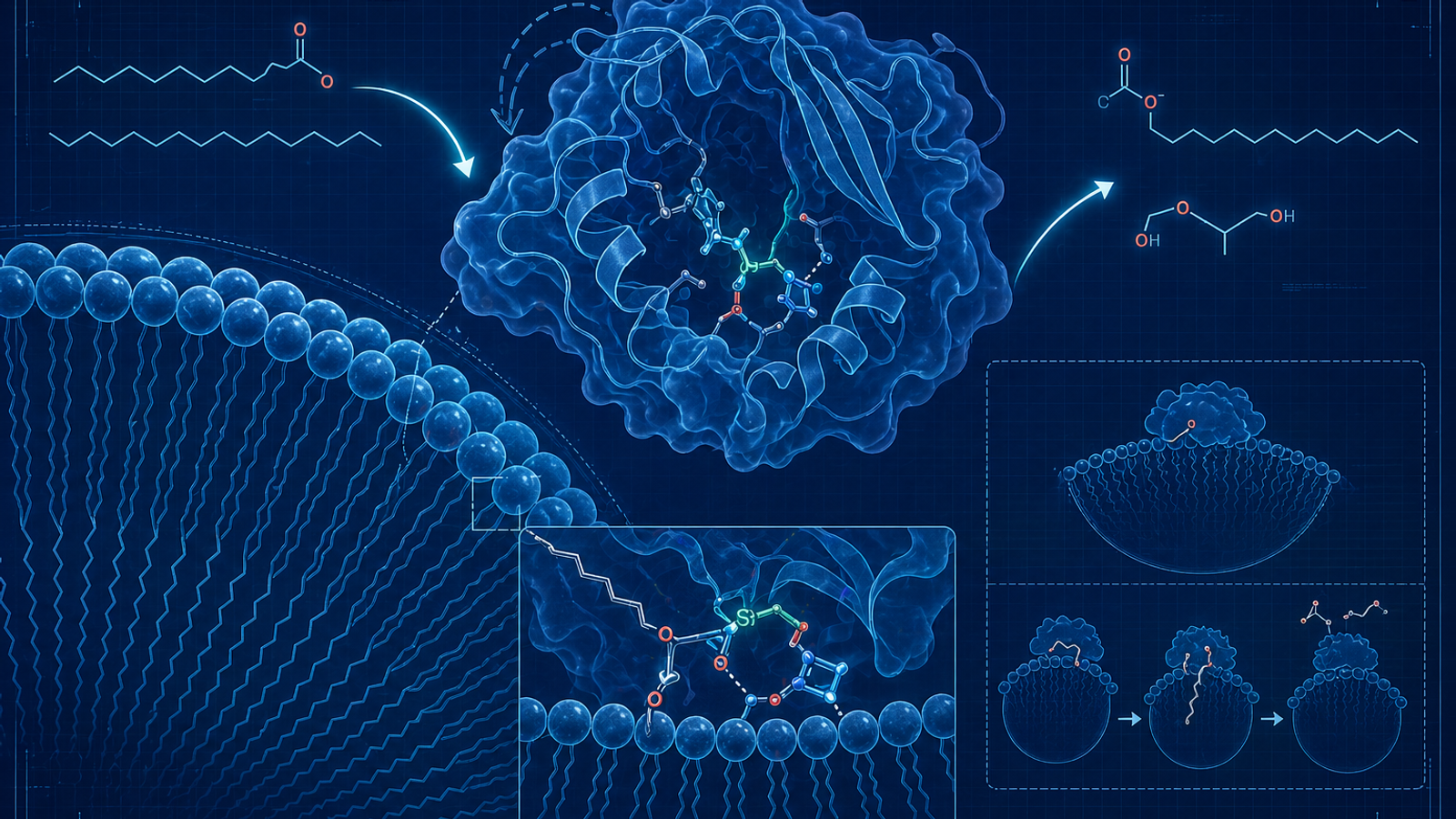
Lipases are enzymes that catalyze the hydrolysis and synthesis of ester bonds in lipid-based substrates. In biological systems, they commonly participate in the breakdown of fats into fatty acids and glycerol, but their importance extends well beyond digestion and lipid metabolism. In biotechnology, lipases are highly valued because they can act at lipid–water interfaces, tolerate a wide range of reaction conditions, and catalyze reactions with high regioselectivity, chemoselectivity, and stereoselectivity. These properties make them useful biocatalysts for industries that require precise and efficient chemical transformations (Anobom et al., 2014; Borrelli & Trono, 2015; Sarmah et al., 2018).
One of the most distinctive features of many lipases is interfacial activation. Unlike enzymes that act only in fully aqueous environments, many lipases become more active when they encounter an oil–water interface. This behavior is often associated with structural elements such as movable lids or surface loops that shift to expose the active site, allowing hydrophobic lipid substrates to enter. Interfacial activation makes lipases especially important from both mechanistic and engineering perspectives because small structural changes can strongly influence catalytic performance and substrate preference (Anobom et al., 2014; Enespa et al., 2023).
Lipases are widely used in detergent formulations because they help remove fat-based stains under relatively mild washing conditions. They are also important in food processing, where they contribute to flavor development, texture modification, fat restructuring, and the production of specialty lipids. In pharmaceutical and fine-chemical synthesis, lipases are valued for stereoselective reactions, which allow the preparation of molecules with specific three-dimensional arrangements that are often essential for biological activity (Adlercreutz, 2013; Coelho & Orlandelli, 2021; Contesini et al., 2020).
Another important application of lipases is biodiesel production. Lipases can catalyze transesterification reactions that convert oils or fats into fatty acid esters, offering a milder and potentially greener alternative to conventional chemical catalysts. Although enzyme cost, operational stability, alcohol inhibition, and reaction efficiency remain practical challenges, lipase-catalyzed biodiesel production continues to attract attention because it can reduce waste generation, improve product specificity, and operate under less severe reaction conditions (Adlercreutz, 2013; Borrelli & Trono, 2015; Kumar et al., 2023).
Engineering lipases commonly focuses on improving thermostability, solvent tolerance, substrate specificity, catalytic efficiency, and expression yield. Mutations near the active site, lid region, or substrate-binding pocket can alter chain-length preference and substrate selectivity, while surface modifications may improve stability in organic solvents or harsh industrial environments. Immobilization on solid supports is another widely used strategy because it can enable enzyme reuse, improve operational stability, and sometimes enhance resistance to heat, solvents, and mechanical stress (Adlercreutz, 2013; Albayati et al., 2020; Contesini et al., 2020).
The continued study of lipases shows how a single enzyme family can connect molecular biology, structural biology, industrial chemistry, and sustainability. Their natural diversity provides a rich foundation for discovering new catalytic functions, while modern protein engineering, recombinant expression, and immobilization technologies allow researchers to tailor lipases for specific industrial needs. As biotechnology moves toward cleaner and more selective production processes, lipases remain central examples of how enzymes can transform industrial practice (Borrelli & Trono, 2015; Sarmah et al., 2018; Eskandari et al., 2024).
References
Adlercreutz, P. (2013). Immobilisation and application of lipases in organic media. Chemical Society Reviews. https://pubs.rsc.org/en/content/articlehtml/2013/cs/c3cs35446f
Albayati, S. H., Masomian, M., Ishak, S. N. H., & others. (2020). Main structural targets for engineering lipase substrate specificity. Catalysts. https://www.mdpi.com/2073-4344/10/7/747
Anobom, C. D., Pinheiro, A. S., De-Andrade, R. A., Aguieiras, E. C. G., Andrade, G. C., Moura, M. V., Almeida, R. V., & Freire, D. M. G. (2014). From structure to catalysis: Recent developments in the biotechnological applications of lipases. BioMed Research International. onlinelibrary.wiley.com
Borrelli, G. M., & Trono, D. (2015). Recombinant lipases and phospholipases and their use as biocatalysts for industrial applications. International Journal of Molecular Sciences. https://www.mdpi.com/1422-0067/16/9/20774
Coelho, A. L. S., & Orlandelli, R. C. (2021). Immobilized microbial lipases in the food industry: A systematic literature review. Critical Reviews in Food Science and Nutrition. https://www.tandfonline.com/doi/abs/10.1080/10408398.2020.1764489
Contesini, F. J., Davanço, M. G., Borin, G. P., Vanegas, K. G., Cirino, J. P. G., Melo, R. R., & Mortensen, U. H. (2020). Advances in recombinant lipases: Production, engineering, immobilization and application in the pharmaceutical industry. Catalysts. https://www.mdpi.com/2073-4344/10/9/1032
Enespa, Chandra, P., & Singh, D. P. (2023). Sources, purification, immobilization and industrial applications of microbial lipases: An overview. Critical Reviews in Food Science and Nutrition. https://www.tandfonline.com/doi/abs/10.1080/10408398.2022.2038076
Eskandari, A., Leow, T. C., & Rahman, M. B. A. (2024). Recent insight into the advances and prospects of microbial lipases and their potential applications in industry. International Microbiology. https://link.springer.com/article/10.1007/s10123-024-00498-7
Kumar, A., Verma, V., Dubey, V. K., Srivastava, A., & others. (2023). Industrial applications of fungal lipases: A review. Frontiers in Microbiology. https://www.frontiersin.org/journals/microbiology/articles/10.3389/fmicb.2023.1142536/full
Sarmah, N., Revathi, D., Sheelu, G., Rani, K. Y., Sridhar, S., Mehtab, V., & Sumana, C. (2018). Recent advances on sources and industrial applications of lipases. Biotechnology Progress. https://aiche.onlinelibrary.wiley.com/doi/abs/10.1002/btpr.2581