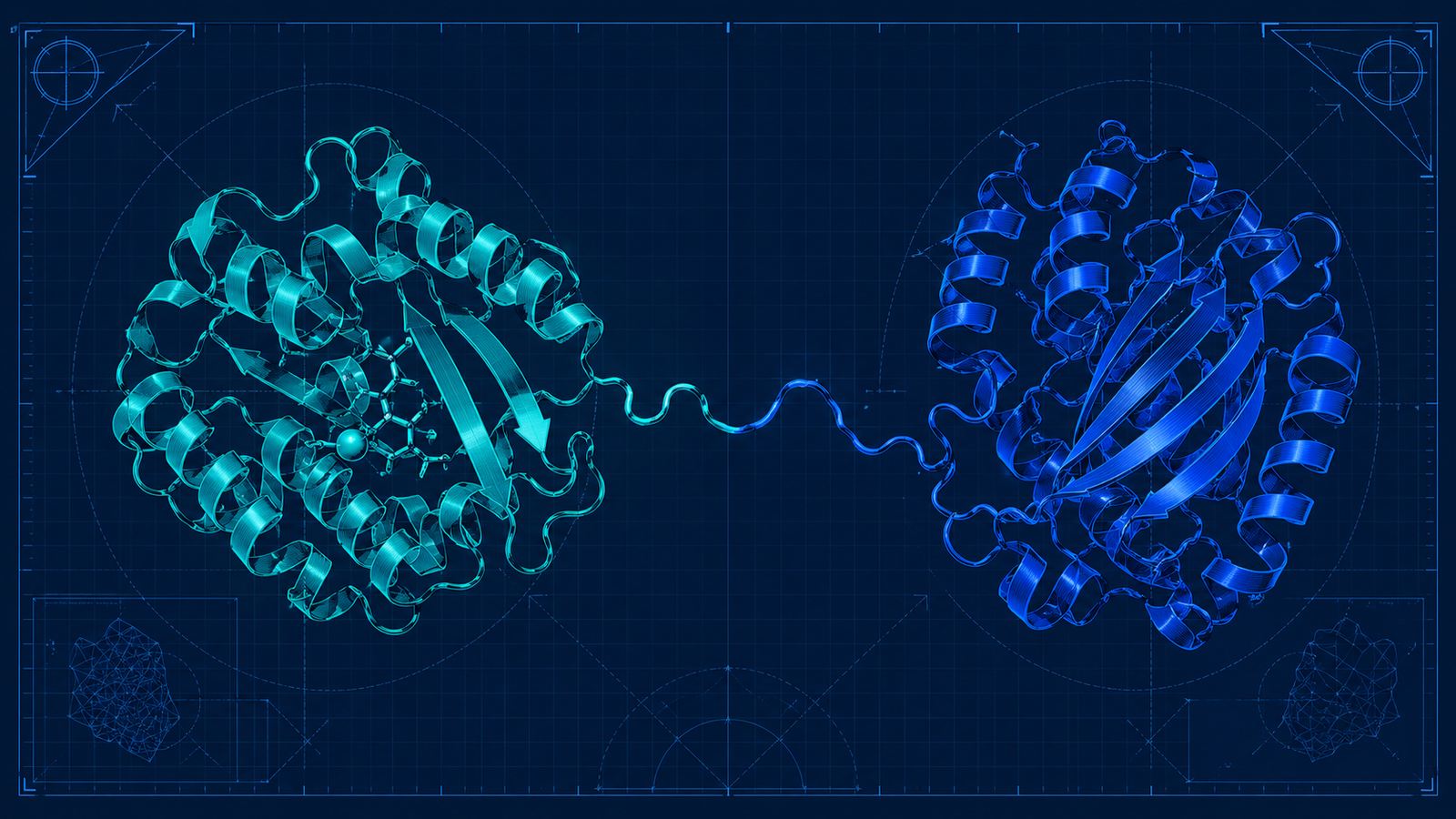
Many natural proteins are modular, containing domains that can fold semi-independently and contribute distinct functions such as substrate recognition, cofactor binding, molecular interaction, localization, or regulation. Domain fusion takes advantage of this modular organization by combining a target enzyme with an additional protein segment to create a new engineered architecture. Depending on the design goal, the added domain may improve solubility, increase stability, alter cellular localization, introduce a binding function, or bring two catalytic activities into closer spatial proximity (Chen et al., 2013; Yang et al., 2016; Elleuche, 2015).
Fusion strategies are already common in recombinant protein production. Solubility and purification tags such as maltose-binding protein, glutathione S-transferase, thioredoxin, and polyhistidine tags are widely used to increase soluble expression or simplify downstream purification. In enzyme engineering, however, domain fusion can serve a broader functional purpose. Stabilizing domains, substrate-binding modules, scaffold domains, or interaction motifs can be attached to influence enzyme folding, stability, substrate access, or catalytic organization. In this sense, the enzyme is not treated as an isolated catalytic unit but as part of a larger engineered protein system (Costa et al., 2014; Walls & Loughran, 2010; Yang et al., 2016).
The linker connecting the fused domains is a critical design element. If the linker is too short, the domains may sterically interfere with each other, restrict necessary conformational movement, or disrupt folding. If it is too long, the fusion protein may become excessively flexible, which can reduce stability, complicate purification, or weaken productive interdomain communication. Linker composition is also important: flexible glycine- and serine-rich linkers often allow domain mobility, whereas rigid or helical linkers can maintain spatial separation and reduce unwanted domain contact. Therefore, linker length, flexibility, and sequence composition must be selected according to the structural and functional requirements of the fusion protein (Chen et al., 2013; Li et al., 2016).
Domain fusion can improve thermostability through several possible mechanisms. A fused domain may stabilize a weak region of the enzyme, increase folding cooperativity, reduce local unfolding, or promote favorable interdomain interactions. In some cases, fusion to thermophilic or structurally stable domains can enhance the thermal tolerance of a less stable enzyme. Domain fusion may also improve solubility by changing the surface properties of the final construct or by reducing aggregation-prone behavior. However, fusion does not automatically improve performance. Poorly positioned domains may reduce catalytic activity, block substrate access, interfere with folding, or increase aggregation (Kim et al., 2009; Yang et al., 2016; Zhu et al., 2024).
Successful domain-fusion design requires both structural reasoning and experimental validation. Predicted or experimentally solved structures can help evaluate domain orientation, linker exposure, possible steric clashes, and the accessibility of the catalytic site. Biochemical assays are then needed to determine whether the fusion protein remains active. Thermal-shift assays, residual-activity measurements, solubility analysis, size-exclusion chromatography, and oligomeric-state characterization can reveal whether the added domain genuinely improves the enzyme or merely changes its physical behavior (Chen et al., 2013; Tong et al., 2022; Nilpa et al., 2022).
Domain fusion remains one of the most creative strategies in protein engineering because it allows researchers to construct proteins with new architectures rather than modifying one residue at a time. As computational modeling and structure prediction improve, fusion designs can increasingly be guided by domain orientation, linker geometry, surface compatibility, and predicted stability. The central challenge is to preserve the natural logic of protein folding while introducing new functional possibilities. When designed carefully, domain fusion can transform enzymes into more stable, soluble, multifunctional, and application-ready biocatalysts.
References
Chen, X., Zaro, J. L., & Shen, W.-C. (2013). Fusion protein linkers: Property, design and functionality. Advanced Drug Delivery Reviews. https://www.sciencedirect.com/science/article/pii/S0169409X12003006
Costa, S., Almeida, A., Castro, A., & Domingues, L. (2014). Fusion tags for protein solubility, purification and immunogenicity in Escherichia coli: The novel Fh8 system. Frontiers in Microbiology. https://www.frontiersin.org/journals/microbiology/articles/10.3389/fmicb.2014.00063/full
Elleuche, S. (2015). Bringing functions together with fusion enzymes—from nature’s inventions to biotechnological applications. Applied Microbiology and Biotechnology. https://link.springer.com/article/10.1007/s00253-014-6315-1
Kim, C. S., Pierre, B., & Ostermeier, M. (2009). Enzyme stabilization by domain insertion into a thermophilic protein. Protein Engineering, Design and Selection. https://academic.oup.com/peds/article-abstract/22/10/615/1547091
Li, G., Huang, Z., Zhang, C., Dong, B. J., Guo, R. H., & Yue, H. W. (2016). Construction of a linker library with widely controllable flexibility for fusion protein design. Applied Microbiology and Biotechnology. https://link.springer.com/article/10.1007/s00253-015-6985-3
Nilpa, P., Chintan, K., Sayyed, R. Z., El Enshasy, H., & others. (2022). Formation of recombinant bifunctional fusion protein: A newer approach to combine the activities of two enzymes in a single protein. PLOS ONE. journals.plos.org
Tong, C. L., Kanwar, N., Morrone, D. J., & others. (2022). Nature-inspired engineering of an artificial ligase enzyme by domain fusion. Nucleic Acids Research. https://academic.oup.com/nar/article-abstract/50/19/11175/6761750
Walls, D., & Loughran, S. T. (2010). Tagging recombinant proteins to enhance solubility and aid purification. Protein Chromatography: Methods and Protocols. https://link.springer.com/protocol/10.1007/978-1-60761-913-0_9
Yang, H., Liu, L., & Xu, F. (2016). The promises and challenges of fusion constructs in protein biochemistry and enzymology. Applied Microbiology and Biotechnology. https://link.springer.com/article/10.1007/s00253-016-7795-y
Zhu, J., Han, S., & Gao, L. (2024). A review of chimeric proteins/enzymes. BIO Web of Conferences. https://www.bio-conferences.org/articles/bioconf/abs/2024/30/bioconf_icbb2024_01017/bioconf_icbb2024_01017.html