Article
Scientists Discover a Reverse Transcriptase That Builds DNA Without RNA
Scientists have discovered DRT7, an unusual bacterial reverse transcriptase that can initiate DNA synthesis without a complementary nucleic acid template. The antiviral enzyme uses protein-templated synthesis and works with a primase–polymerase to generate long, palindromic A/T-rich DNA.
By Xin-Yi Song, Yushan Xia, Jun-Tao Zhang, Xin-Yang Wei, Hua Qi, Linshu Li, and Ning Jia
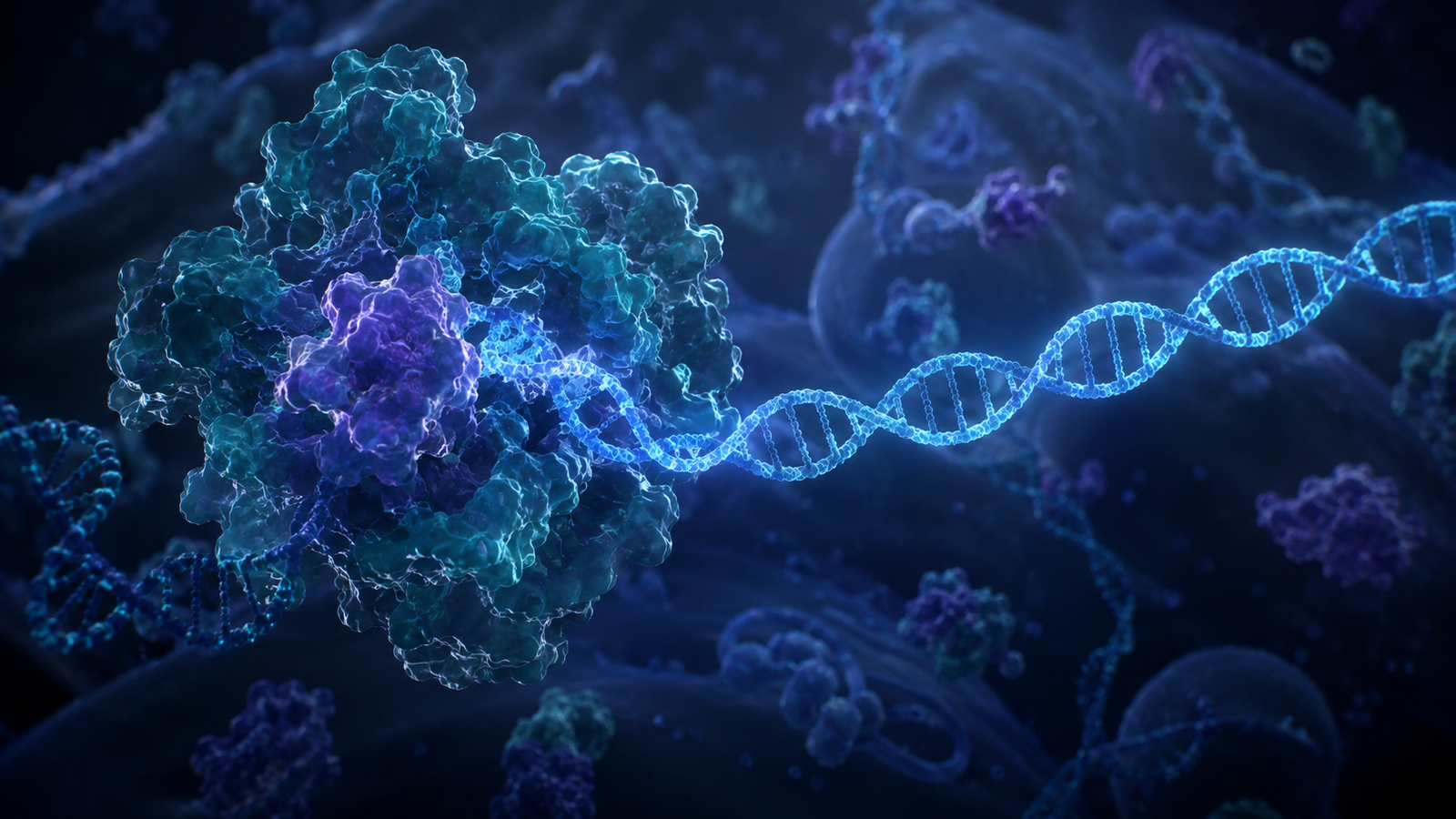
A Bacterial Enzyme Has Revealed an Unexpected Way to Make DNA
For decades, reverse transcriptase has been associated with a familiar molecular operation: reading RNA and producing a DNA copy. But bacteria appear to have pushed this chemistry into much stranger territory.
Researchers studying bacterial defenses against viruses have characterized an enzyme called DRT7 that can initiate DNA synthesis without relying on a complementary RNA or DNA template. Instead, part of the enzyme itself helps determine what DNA is produced. The result is an unusual form of protein-templated DNA synthesis that expands the conventional picture of what reverse transcriptases can do—and bacteria may be using this chemistry as a weapon against viruses.
The findings, reported by Xin-Yi Song and colleagues in a 2026 bioRxiv preprint, describe a sophisticated antiviral system in which two DNA-synthesizing activities work together to generate long, repetitive DNA molecules during bacteriophage infection. The study has not yet been peer reviewed, but genetic experiments, biochemical assays, DNA sequencing and cryo-electron microscopy converge on a detailed mechanistic model of how the system operates.
An Unusual Addition to the Bacterial Antiviral Arsenal
Bacteria may be simple cells, but they exist under relentless viral pressure. Their viruses, known as bacteriophages, attach to bacterial cells, inject their genetic material and attempt to hijack the cell's machinery to produce another generation of viruses. This ancient evolutionary conflict has driven bacteria to evolve an extraordinary diversity of immune mechanisms.
CRISPR is the most famous example, but it represents only one part of this defensive arsenal. In recent years, researchers have discovered numerous bacterial antiviral systems involving reverse transcriptases, enzymes best known for converting RNA into DNA.
DRT7 belongs to this expanding family of defense-associated reverse transcriptases, but its architecture immediately sets it apart. The same protein contains both a reverse transcriptase (RT) domain and a primase–polymerase (PP) domain, effectively combining two catalytic machines within a single molecular system.
Song and colleagues set out to understand why bacteria had brought these activities together and, more importantly, what the combined enzyme actually does when a phage attacks.
DRT7 Can Cause Phage Infection to Collapse
To test its defensive activity, the researchers introduced DRT7 from an Escherichia coli strain into laboratory E. coli and challenged the cells with different bacteriophages. The protection was substantial: against some phages, DRT7 reduced plaque-forming efficiency by roughly six orders of magnitude.
The enzyme did not appear to prevent phages from attaching to the bacterial surface. Instead, the defense acted after adsorption, disrupting the infection before the invading virus could successfully produce and release new phage particles.
The experiments pointed toward an abortive infection strategy. Rather than necessarily saving an infected bacterium, abortive infection prevents that cell from becoming a productive viral factory. The individual cell may be sacrificed, but stopping viral replication can protect neighboring bacteria by preventing the phage population from spreading.
The researchers also uncovered a clue about how the defense recognizes an infection. Independently evolved phages capable of escaping DRT7 carried mutations in a gene called Bas63-035, which is predicted to encode a transcriptional regulator. When this phage protein was expressed together with DRT7, it caused cellular toxicity, suggesting that a molecule made by the invading phage can help trigger the defense.
What happens after that activation, however, is where DRT7 becomes particularly unusual.
DRT7 Begins Building DNA of Its Own
When purified DRT7 was supplied with the molecular building blocks needed for DNA synthesis, the enzyme began producing DNA. Crucially, the newly synthesized material remained covalently attached to the protein, indicating that DRT7 itself provides the starting point for the reaction.
Sequencing revealed that this DNA was unlike an ordinary genomic sequence. It consisted almost entirely of just two bases, adenine (A) and thymine (T). PacBio sequencing measured approximately 50.1% adenine and 48.3% thymine, with the products averaging about 1,812 nucleotides in length.
These bases were not arranged randomly. Instead, the molecules contained alternating stretches of poly(A) and poly(T), organized in a way that produced extensive self-complementarity. As a result, a single DNA strand could fold back on itself and form stable, duplex-like hairpin structures.
DRT7, in other words, was not simply making DNA. It was manufacturing DNA with a highly distinctive composition, sequence organization and three-dimensional architecture.
How Do You Make DNA When There Is Nothing to Copy?
This is the most conceptually striking part of the study.
Polymerases normally depend on information encoded in an existing nucleic-acid template. Complementary base pairing tells the enzyme which nucleotide should be incorporated next. Yet the initial reaction performed by DRT7 does not require a complementary RNA or DNA strand.
Cryo-electron microscopy offered an explanation for how that may be possible. Within DRT7's reverse-transcriptase region, the researchers identified an arginine-rich recognition pocket that selectively accommodates thymidine. Four arginine residues—R440, R447, R595 and R750—contribute to interactions that favor thymidine during the initial synthesis reaction.
Mutating important residues within this system disrupted DNA synthesis and eliminated antiviral activity, linking the unusual molecular recognition mechanism directly to the protein's defensive function.
This is why calling the reaction simply “template-free” does not fully capture what is happening. There may be no conventional nucleic-acid template, but the synthesis is not chemically unconstrained. Instead, the protein's own architecture provides a sequence-selective environment that helps specify the DNA product.
The authors therefore describe the process as protein-templated DNA synthesis.
One Protein, Two DNA-Making Machines
The reverse transcriptase is only the first half of the process. Once DRT7's RT domain produces the initial thymine-rich DNA, its second catalytic component—the primase–polymerase domain—helps extend it.
The proposed sequence of events can be summarized as:
DRT7 protein → poly(T) → poly(A) → poly(T) → poly(A) → long palindromic A/T-rich DNA
First, the RT domain generates protein-primed poly(T). That newly synthesized poly(T) can then function in the next stage of the reaction, allowing the PP domain to extend the molecule with poly(A). The growing DNA can subsequently return to the RT domain for another round of poly(T) synthesis before being handed back to the PP domain again.
Through repeated cycles, the two catalytic domains progressively build long molecules containing alternating A- and T-rich tracts.
Song and colleagues describe this as an iterative handoff between the RT and PP domains. Rather than behaving like a conventional single-purpose polymerase, DRT7 operates more like a compact molecular production line in which two different catalytic activities repeatedly cooperate on the same growing DNA product.Then it can return again to the PP domain.
And the cycle continues.
The authors describe this as an iterative handoff between the RT and PP domains. Repeated cycles gradually generate the long alternating A/T-rich molecules observed by sequencing.
This makes DRT7 less like a single-purpose enzyme and more like a miniature molecular production line.

Activation Physically Reshapes the Enzyme
The structural data suggest that this biochemical handoff is accompanied by a dramatic physical transformation of the protein itself.
DRT7 forms a dimer, meaning that two copies of the protein associate with one another. In the proposed inactive state, cryo-electron microscopy revealed a relatively closed arrangement containing a short protein-linked poly(T) strand of approximately 10 nucleotides.
As DNA synthesis progresses, however, the organization changes substantially. One side of the dimer remains comparatively closed and appears to function as a structural scaffold, while the other undergoes extensive rearrangement into a catalytically active configuration.
Among the most striking movements, the protein's middle domain rotates by approximately 180 degrees, while the PP domain is repositioned by roughly 90 degrees. Mutations that disrupted interfaces required for this open architecture also abolished antiviral defense.
The structural observations therefore connect DNA synthesis with a larger conformational switch: as the DNA product elongates, DRT7 reorganizes from a closed state into an open, catalytically active assembly.

What Does This Strange DNA Actually Do?
That remains the biggest unanswered question.
The study establishes a strong connection between DRT7-mediated DNA synthesis and antiviral defense, but it does not yet show exactly how the resulting A/T-rich DNA prevents successful phage infection.
One possibility raised by the researchers is that the unusual self-complementary DNA structures somehow interfere with viral DNA replication or transcription. Because the products contain complementary A- and T-rich regions, they can fold into stable structures resembling double-stranded DNA while remaining part of a protein-linked molecule.
The architecture of the DNA may therefore be more important than its precise sequence. For now, however, the proposed downstream mechanism remains a hypothesis that will require additional experiments.
There is another unresolved part of the activation process. Although the researchers identified a phage-encoded protein associated with DRT7 activation inside bacterial cells, that protein alone did not stimulate DRT7 DNA synthesis in a purified test-tube system. This suggests that another cellular factor—or a particular molecular condition created during infection—may be required to fully activate the system.
Why DRT7 Matters Beyond Bacterial Immunity
DRT7 adds another unexpected chapter to the rapidly changing biology of reverse transcriptases.
These enzymes were once discussed primarily in the context of retroviruses, retroelements and other mobile genetic systems. It is now clear that bacteria have repeatedly recruited reverse transcriptases for antiviral defense, sometimes incorporating them into molecular pathways that look very different from conventional RNA-to-DNA copying.
DRT7 pushes that versatility further. Here, reverse-transcriptase activity is coupled directly to another polymerase activity, allowing one protein complex to initiate an unusual DNA product and then repeatedly extend it through coordinated catalytic cycles.
More fundamentally, the work demonstrates that a protein can do more than simply catalyze DNA synthesis: its own molecular architecture can help determine the sequence being synthesized even in the absence of a conventional complementary nucleic-acid template.
That possibility may eventually have technological implications. Protein-guided DNA synthesis could be interesting for synthetic biology or genome engineering because it raises the prospect of designing enzymes that generate defined nucleic-acid products through mechanisms that are not entirely dependent on conventional templates. Song and colleagues suggest that DRT-like enzymes could eventually provide a foundation for programmable DNA synthesis.
For now, however, that remains a future possibility rather than an application demonstrated by the study.
A New Addition to Biology's DNA-Making Toolkit
Perhaps the most important lesson from DRT7 is simply that biology has evolved more ways of making DNA than the textbook picture might suggest.
This bacterial protein appears capable of providing the molecular starting point for DNA synthesis, creating a sequence-selective environment that favors a particular nucleotide, coordinating two different polymerase activities, repeatedly passing a growing DNA molecule between them and ultimately generating long, self-complementary DNA structures as part of an antiviral response.
None of this overturns the established principles of DNA replication or the central dogma. Instead, it reveals another biochemical solution produced by the ancient evolutionary arms race between bacteria and the viruses that infect them.
That is particularly intriguing because bacterial antiviral systems have a history of revealing biology that later becomes technologically useful. CRISPR is the obvious example, although there is currently no reason to assume that DRT7 will follow the same trajectory.
Its significance today is more fundamental.
DRT7 reveals that a protein can participate not only in catalyzing DNA synthesis, but also in determining what DNA gets made. In doing so, it expands the known repertoire of molecular strategies that living systems can use to construct nucleic acids.
Preprint posted in April 2026; not yet peer reviewed.
FAQ
Frequently asked questions
DRT7 is a bacterial defense-associated reverse transcriptase containing both reverse transcriptase and primase–polymerase domains. It helps bacteria defend against bacteriophages through an abortive infection mechanism.
DRT7's reverse transcriptase uses a protein-based recognition mechanism to initiate thymidine-specific DNA synthesis without requiring a complementary nucleic acid template. The resulting poly(T) DNA then acts as a primer and template for further DNA synthesis.
DRT7 produces long, protein-primed DNA dominated by alternating poly(A) and poly(T) sequences. These palindromic sequences can fold back into self-complementary, duplex-like structures.
The experiments indicate that DRT7 restricts bacteriophage propagation through abortive infection. An infected bacterial cell arrests growth, limiting the virus's ability to produce and release progeny.
Potentially, but applications have not yet been demonstrated. The researchers suggest that DRT-like enzymes could provide a foundation for future programmable DNA synthesis technologies.
No. The manuscript was posted as a bioRxiv preprint on April 19, 2026, and the version analyzed here was explicitly marked as not certified by peer review.
More from this website
Related articles

SPICE Protein Complex Analysis
SPICE is a web-based platform for rapid analysis of protein complexes

CKS1B & T Cell Exhaustion
CKS1B drives T cell exhaustion in cancer by suppressing type I interferon signaling

Preemptive Cardioprotection with a Small Molecule
A new small molecule, BT2, has shown promising results in reducing heart damage caused by ischemia-reperfusion injury, offering new hope for heart disease treatment.